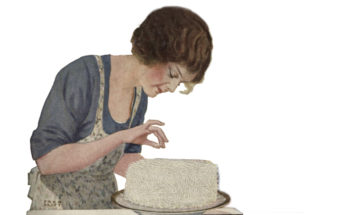
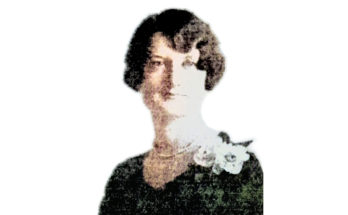
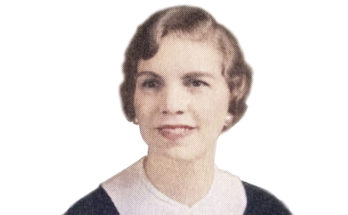
While going through posts of antique marshmallow booklets by Taste of History on Cookbook Collectors and Lovers on Facebook, I kept running into Marshmallow Creme booklets by Emma E. Curtis. At first it seemed straightforward, but the deeper I looked, the more questions came up—about who was creating what products, and who was being credited for it. This is where that trail led.
Emma E. Curtis’s brother, Amory, had a soda fountain hardware, fruit extracts, and syrups business going back to the 1890s, so I can’t help but speculate that in her 30s, Emma may have been making most of the creams and syrups, while her MIT-accepted brother focused on the engineering side of things. But what exactly was Amory accepted for at MIT—chemistry? engineering? That detail would make a difference.
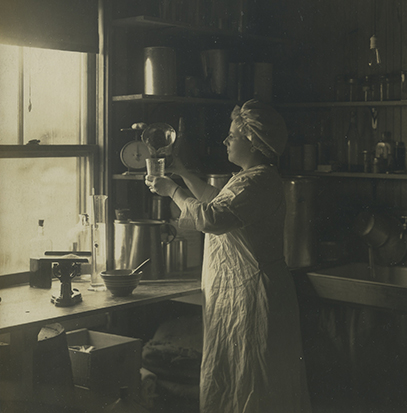
Downton Abbey Cooks words their article in a way that could give the credit to her brother, saying something like, “Amory…a soda equipment company…sold the company to build a house on Crystal Street and in the basement created a marshmallow spread known as Snowflake Marshmallow Creme.” But that wording makes me pause—who actually created the formulas? Here’s an image so we can at least question it. Photo courtesy of Melrose Public Library, NOBLE Digital Heritage. And as we discover after the sibling’s deaths, the company was legally called “Emma E. Curtis, Inc.”
Variations of marshmallow recipes were already circulating in the 1800s–can we find a marshmallow creme recipe in an antique cookbook?
So, Amory bought the house in 1901 that became the creme factory, and their product is often given the status of being the first commercially successful shelf-stable marshmallow cream. But then Limpert Brothers had a named product by 1910–but not shelf-stable?–and Whitman’s Marshmallow Whip showed up in 1913—said to be before Emma. Except…1913 was the year Emma Curtis was already advertising for a sales force for the product.
In 1915 Miss Curtis’s Snowflake Marshmallow Creme won a gold medal at the Panama Pacific Expo. But in 1922 Amory changed the award-winner’s name to Miss Curtis’s SMAC Marshmallow. Did Amory want a bit of the award-winning credit? –SMAC stands for “Snowflake Marshmallow Amory Curtis.“
Emma Curtis’s 1918 Liberty Sandwich—marshmallow creme and peanut butter, printed on their jars after 1922—is later credited as the first “Fluffernutter.” But even before that, in 1915, there was a similar Mallonut Sandwich mentioned in the trade magazine Candy and Ice Cream. The Marshmallow Fluff company has its own interesting [later] history beginning in circa 1917-1920s, only 7 miles away from the Curtis’s factory. Who inspired who?
It was mentioned that Emma Curtis had a radio show—probably one of those 10- or 15-minute advertorials, maybe in the late 1920s or 1930s. I would love to hear that.
Emma died Sept. 6, 1948 at 85 years, Armory died in 1950. He may not have afforded MIT early in his career, but eventually graduated from Harvard. The last I saw an ad for Miss Curtis’s Marshmallow Creme in the stores was 1951–the company, technically called “Emma E. Curtis, Inc.” was sold that year at auction, and perhaps purchased by their cousin. The factory continued until 1962, corresponding to when Marshmallow Fluff got legs.