Ice Box

by Rena

In 1900 the average family purchased 2.5 tons of ice per year for the ice box at 30 cents/100 pounds. The price doubled to 60 cents/100 pounds in the same year after “The Ice King” Charles W. Morse, American Ice Company, established a monopoly in ice.

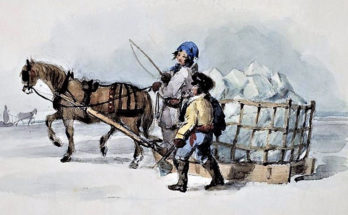
Blocks of ice were often kept in sawdust while being delivered by the iceman, and the frugal housekeeper wrapped the ice block in newspaper to prolong its life.[1]

6.25 gallons of water make a 50 pound block of ice.

Visit Knowlton Ice Museum in Port Huron for more discoveries about the ice industry, and Rentschler Farm Museum for a family-farm ice house.


Seventh Annual Catalogue, Revised Edition, 1892, Challenge Iceburg Refrigerators

The term “refrigerator” was coined by a Maryland engineer, Thomas Moore, in 1800. Moore’s device would now be called an “ice box” — a cedar tub, insulated with rabbit fur, filled with ice, surrounding a sheet metal container. Moore designed it as as a means for transporting butter from rural Maryland to Washington, DC. Its operating principle was the latent heat of fusion associated with melting ice.[2]

[1] Memories of Morse 1904-1979, “Charles Wyman Morse” by John Paul Heffernan, Brunswick Publishing Co., Brunswick, Maine. [2] Refrigerators, by Glenn Elert.

Michigan’s Colonial Michilimackinac on Mackinac Island is a preserved fur-trading village representing 1770s life. There is much to see, including demonstrations of open hearth cooking.

Navarre-Anderson Trading Post is another 1700s fur-trading post museum which contains the oldest surviving wooden residential building in Michigan — and an 1810 cookhouse!

It is always 1932 at Wellington Farm, USA in Michigan. The Summer Kitchen is equipped for the housekeeper of the Great Depression, and is a working kitchen for demonstrations and special events. A Grist Mill is nearby milling corn for cornmeal, barley for flour, or shelling corn.

While you’re in Michigan, visit the authentic logging cook shack at the Tahquamenon Logging Museum in Newberry.

Flickr has some great kitchen photos…I’ve sorted through to find the best kitchen scenes.

Vintage Reinactments

Good Old Days

Tradition Lives On…

In the early 1800s America had her own native spices and herbs, and merchants from Salem Massachusetts still traded for exotic spices from the far east.

Mid-1800s refrigeration in ships lessened the status and prices of the spice trade, but demand and competition was still keen.

1869: a spice mill was added to Hulman & Company’s [Clabber Girl] grocery store wholesale business.

1873: Tone Brothers, Inc. founded and still located in Des Moines, Iowa, today is perhaps second in volume to McCormick, and distributes Durkee Spices, Fleischmann’s Yeast, and Spice Islands products. Tone is also the leading supplier of spices to national warehouse club chains.[1]

1889: Willoughby M. McCormick founded McCormick Spices in Baltimore, working out of one room and a cellar. The initial products were sold door-to-door and included root beer, flavoring extracts, fruit syrups and juices. Seven years later, McCormick bought the F.G. Emmett Spice Company and entered the spice industry….

“Make the Best – Someone Will Buy It.” [2]

Late-1900s: Fewer home cooks drastically decreased the volume of the spice market.

Antique Stoves

by Rena

Antique Stove display extravaganza — and they’re for sale!

  • Bryant Stove & Music, Inc. in Thorndike Maine. Atlantic Stoves, Clarion Stoves, Crawford Stoves, Glenwood Stoves,
    Kineo Stoves, and Misc. Stoves

You will find an on-the-farm pork butchering display to the farm family kitchen and more at the Family Farm in Frederick, Maryland! The farm museum recreates the life of a family farm during the late-19th century and early-20th century.

Raye’s Mustard Mill Museum is a working stone-ground mustard mill and mustard shop in Eastport, Maine. The family began making mustard to compliment the local sardine industry.

Speaking of sardines, there is a Sardine Museum in Lubec, Maine — travel from the mustard museum either 38 miles by car, or only 4 miles by boat.

Acadian 1950s kitchen from the Pelletier-Marquis House Museum in St. Agatha, near Canada in upstate Maine

The Albert House in Madawaska, Maine property stayed in the Albert family from when it was granted to them by the King in 1786 until 1970. Now it is a museum and contains this early-1800s country kitchen.

Westwego Historical Society arranged a splendid early kitchen at the Westwego Historical Museum. See the kitchen picture on their website.

At the Laurel Valley Village/Plantation Museum and Country Store in Thibodaux, Louisiana you can visit the sugar cane plantation museum and view the outside of the historic sugar cane farming village left intact.

You will find 3 kitchen displays and a moonshine still at The McCreary Museum in Kentucky representing different eras. One kitchen represents 1790, another circa 1900, and lastly, a 1920s Miner’s kitchen. Is that a plastic tablecloth in the picture?

Another moonshine still is displayed in Kentucky at Barthell Coal Mining Camp.

Note the kitchen wallpaper at Granny’s house.

Kentucky Fried Chicken’s founder Colonel Sanders first pressure-cooked his famous fried chicken in a 6-seat lunchroom at a gas station. A replica of the kitchen is on display at the original lunchroom location at the Kentucky Fried Chicken® in Corbin Kentucky.

Wow! The American Museum of Baking in Manhattan has samples of Egyptian bread, cake more than 3,800 years old, priceless 200 year old baking books, and much more!

The first two full weeks of every June in Abilene Kansas
children attend Pioneer Camp where they churn butter, cook and discover the other skills needed to live 100 years ago.
Call Heritage Center of Dickinson County 785-263-2681.

Valentine Diners were made of metal and manufactured
in Kansas. On their website you’ll discover the history
of these pre-fabricated metal lunchrooms and diners —
even including the White Castle buildings.

For a closer look at the early fast-food industry
visit the Kansas Museum of History in Topeka.

The Grenola Elevator Museum in Grenola, Kansas

Ever want to see the inside of a grain mill and elevator?
Here is your chance with an opportunity to also see a vintage kitchen featuring a Montgomery Ward wood range, Ice Palace ice box, and Ideal cabinet.

More Historic Mills


  • 1960s Ice Cream Soda Fountain
  • 1940s Kitchenology
  • 1914 Table Setting
  • 1600s American Dutch Colonial
  • Kitchen Tours

    by Rena

    You want to get amazing ideas for your kitchen,
    so you tear sheets from magazines and create a scrapbook
    or a desire wheel… But do want to kick it up a notch or 2?

    Try a real-time home kitchen tour!

    Alabama

  • Madison County, Huntsville: Annual Kitchens for CASA

  • California

  • San Mateo: Baywood Kitchen Tour
  • Belvedere-Hawthorne Annual Kitchen Tour
  • Lafayette Annual Kitchen Tour
  • Palo Alto Woman’s Club Spring Kitchen Tour
  • California, Pasadena: ASID Annual Home and Kitchen Tour
  • Rockridge: Annual Kitchen Tour
  • Yolo County Red Cross Heart of the Home Kitchen Tour

  • Connecticut

  • Falls Village: Housatonic Valley Kitchen Tour

  • Colorado

  • Denver: Annual Junior League of Denver Kitchen Tour

  • Delaware

  • New Castle County, Wilmington: Residents of Old Wilmington Back Door Kitchen Tour
  • New Castle County, Wilmington: Junior League of Wilmington Heart of the Home® Kitchen Tours

  • Florida

  • Dade City: Dade City Woman’s Club Kitchen Tour
  • Wabasso: Environmental Studies Council Kitchen Tour

  • Georgia

  • Classic South, Augusta: Augusta Symphony Guild “Heart of the Home Kitchen Tour
  • Metro Atlanta, Atlanta: The Junior League of Atlanta Tour of Kitchens

  • Illinois

  • Chicago area, Oak Park: Annual Parenthesis Kitchen Walk
  • Southern, Mt. Vernon: Mt. Vernon Rotary Club’s Kitchen Tour

  • Kentucky

  • Henderson: Annual OVAL Kitchen Tour
  • Lexington: Kitchens of the Bluegrass Tour

  • Louisiana

  • New Orleans: Junior League of New Orleans Annual Kitchen Tour

  • Maine

  • Bangor: Eastern Maine Medical Center Auxiliary’s Annual Kitchen Tour
  • Kennebunk: Annual Coastal Kitchen Tour

  • Massachusetts

  • Greater Boston, Bedford: B.E.S.T Renovates Kitchen Tour
  • Greater Boston, Melrose: Annual Kitchens of Melrose
  • Greater Boston, Summerville: Scrumptious Summerville Kitchen Tour
  • Greater Boston, Wellesley: The Wellesley Kitchen Tour
  • North Shore, Wenham: Wenham Museum Annual Kitchen Tour
  • Merrimack Valley, Newburyport: Annual Newburyport Kitchen Tour
  • Pioneer Valley, Longmeadow: “Cooks ‘n Kitchens” Kitchen Tour

  • Minnesota

  • Minnetonka: Heart of the Home: NCJW’s Progressive Kitchen Tour

  • Missouri

  • St. Louis: Dream Kitchen Tour

  • New Hampshire

  • Manchester: Annual Kitchen Tour
  • Portsmouth: Annual Kitchen Tour

  • New Jersey

  • Bay Head: Kitchen Tour
  • Glen Ridge: Annual Taste of Glen Ridge Kitchen Tour
  • Pennington: Taste of Toll House Kitchen Tour
  • Spring Lake: Kitchen Tour
  • Toms River: Annual White Pine Twig’s Kitchens Tour
  • Westfield: Hearth & Home Kitchen Tour

  • New York

  • Pittsford: Women’s Club of Pittsford Kitchen Tour
  • Syracuse: Westcott Community Center Annual Kitchen Tour

  • Oklahoma

  • Nichols Hill: Annual Kitchen Tour
  • Oklahoma City: Spicing It Up For a Cure Kitchen Tour

  • Oregon

  • Grants Pass: American Association of University Women [AAUM] Annual Kitchen Tour

  • Pennsylvania

  • Greensburg: Annual Art in the Kitchen Tasting Tour

  • South Dakota

  • Rapid City: Destination Kitchen: Imagine the Possibilities Kitchen Tour

  • Texas

  • Fort Worth: Annual Communities In Schools Kitchens Tour

  • Tennessee

  • Chattanooga: Tour du Jour Kitchen Tour

  • Virginia

  • Roanoke: Annual Virginia Amateur Sports Kitchen Tour
  • Winchester: Annual Kitchen Kapers Tour

  • Historic New England posted 9 historic New England kitchens as part of their celebration of the Year of the Kitchen. Their traveling exhibition “America’s Kitchens” opens at the museum at New Hampshire Historical Society in Concord, NH.

    Le Mars, Iowa is officially the “The Ice Cream Capital of the World.”

    Looks like a Chamber’s stove in the far right photo. What else is at the Monona Historical Museum in Monona, Iowa? If we visit, I’ll let you know pronto! : )

    Wow! Visit the Amana Heritage Society’s 1863-1932 Communal Kitchen Museum when you’re in the area.

    Conveniently, the Hart Dummermuth House Museum staff posted a picture of their 1890s-1900s kitchen on their website : )

    Visit these historic grocery stores if you’re in the neighborhood:

    General Store Museums

    What does this small Pioneer Kitchen building contain?

    Franklin County Historical Museum See the slide in the first column, last row.

    Milk comes from cows — it’s true! But if you knew that, and want to know more about dairy farming, The Iowa Dairy Museum is a go-to source.

    Want to see one early-1900s bottle of kethup? Why not! You can view the kethup bottle with correspondence between the company and a satisfied customer at the Seaford Museum in Seaford, Delaware.

    Read the history of tomato ketchup.

    Clabber Girl Museum in Terre Haute, Indiana

    Candy Museum

    by Rena

    Schimpff’s Confectionery in Jeffersonville, Indiana (Southern Indiana) There is also a candy store at the location.

    Visit the largest collection of pre-1900 marble soda fountains on public display—one from the 1850s!

    More Vintage Soda Fountain Displays

  • Kansas: The Bushton Museum
  • Kansas, Scandia: Scandia Museum — the museum also includes the first house in New Scandinavia [Scandia, KS] with its replicated kitchen.
    Kansas, Belleville: Purple Splash Inc. — working
  • Washington, Yakima: The Soda Fountain – a working soda fountain museum
  • Washington, Tennessee, Cross Plains: Thomas Drugs – a working soda fountain and drug store
  • Nebraska, Omaha: The Durham Museum — 1931 working soda fountain

  • La Cuisine Francois by François Tanty Chicago: Baldwin, Ross & Co.

    BEEF SAUTE A LA STROGONOFF. (Entree.)
    PROPORTIONS.–For five persons:

    Beef (tenderloin, roll or steak)….2 lbs.
    Onion………………………….1.
    Butter…………………………3 tablespoonsful.
    Flour………………………….1 tablespoonful.
    Cream………………………….2 glassesful.
    Worcestershire sauce…………….2 tablespoonsful.

    Time.–25 minutes.

    PREPARATION.–1st. Slice your beef in slices the size of a half dollar but twice as thick. 2d. Let brown 1 chopped onion in a sauce pan with 3 tablespoonsful butter, add the sliced meat and let fry for about 5 minutes. 3d. Sprinkle over 1 tablespoonful flour, 2 glassesful cream, 2 tablespoonsful Worcestershire Sauce. Add some chopped parsley, let cook awhile and serve in a warm hollow dish.

    Video: Chef Gus Tselios’s Beef Stronganoff on Diners Drive-Ins and Dives show hosted by Guy Fieri…

    A 200-Year-Old Tour of Gastronomic Paris
    By Tony Perrottet Published: November 22, 2009
    A food-obsessed traveler uses the Zagat guide of the Napoleonic era to explore the culinary wonders of this city in the 21st century.

    On the Historic Trail of a Parisian Gourmand
    Ed Alcock for The New York Times Published: 2009-11-22
    A culinary guide to the City of Light through a 19th-century foodie

    A 200-Year-Old Tour of Gastronomic Paris
    Published: November 22, 2009
    A Revolutionary-era gourmand financed his appetites by writing about them.

    1870s

    by Rena

    1870s New Foods

    • Saccharin
    • Cubed sugar
    • Synthetic vanilla
    • Rootbeer
    • Wheatena
    • Nestle’s Infant Milk Food
    • Milk chocolate
    • Ice cream soda
    • Commercial production of margarine
    • Japanese beef-eating taboo ends (c. 1870)
    • Chewing Gum from chicle
    • Tone Brothers [spices and coffee]

    1870s New Cooking Gadgets

    • Can opener with cutting wheel.
    • Four-tined silver fork, beginning the end of eating with knife.
    • Square bottomed paper-bags.

    1870s New Food Companies

    • Lipton Pillsbury & Co.
    • F. & J. Heinz
    • Quaker Mills
    • Hills Brothers
    • Grand Union Tea Co.
    • Confectioner’s Journal

    1870s Food Industry Beginnings

    • Milking machines
    • Glass milk bottles
    • Orange crates
    • Pressure cooking in food canning: 1874
    • Frozen meat shipments: 1877
    • Mechanical cream separator
    • Porcelain rollers make roller-milling flour (wheat germ removal) standard practice
    • William Underwood first to register U.S. food trademark (Red Devil)

    1870s Farming Progress

    • Bison herds disappearing
    • Large US agricultural exports
    • European farm land shortage
    • Quantity banana imports to US
    • Long-distance cattle driving
    • Barbed wire fences
    • Vast US acreage for farming and cattle ranches

    1870s Timelines

    1880s

    by Rena

    1880s kitchen

    1880s School of Cookery

    1880s New Cooking Gadgets

    • Hand cream-separators
    • Lenox China
    • Ball-Mason jars introduced [invented in 1857]

    mason jar.


    1880s New Foods

    • Malted milk
    • Powdered pea and beet soups
    • Evaporated milk
    • Aunt Jemima Pancake Flour
    • Coca-Cola
    • Moxie
    • Dr. Pepper
    • Thomas’s English muffins
    • Oscar Mayer wieners
    • Salada Tea
    • Tetley Tea
    • Log Cabin Syrup
    • Morton’s salt
    • Canned meat and fruit in stores: 1880

    1880s New Food Companies

    • McCormick Spices
    • R. T. French
    • Maxwell House
    • B. H. Kroger
    • ConAgra
    • White Lily Foods
    • Lever Brothers
    • Calumet Baking Powder
    • Diamond Crystal Salt
    • American Cereal
    • Manischewitz
    • Pillsbury-Washburn Flour Mills
    • L’Ecole de Cordon Bleu

      1880s Food Industry Beginnings

    • Packaging of grain commodities
    • Efficiencies in railroad meat shipments
    • Pea-viner and podder machine
    • Commercial aluminum production
    • Ice-making plants start replacing ice-cutting industry
    • Self-service restaurant
    • Vending machines for gum 1888

      1880s Farming Progress

    • Long cattle-drives end as railroads enter Texas

    Rikard’s Grist Mill. Watch as corn is ground into cornmeal and grits, and learn about cane syrup making. Open April through December, Saturday only, 9am – 5pm.

    Al Highway 265
    Beatrice, AL‎ 36425
    (251) 575-7433

    Check their website for Special Events

    November 7, 2009: Cane Syrup Making & Pioneer crafts demonstrated.
    Join us for biscuits and syrup and watch a 19th-century mule-driven cane mill and furnace make cane syrup as in olden days. Barbecue will be available. 9 a.m.-4 p.m. For more information, contact Kevin Mannix at (251) 575-7433.

    The Canadian government required those going to the Klondike gold fields to bring a year’s supply of food with them to avoid starvation during the long Yukon winter. Some of the recommended supplies included 400 pounds of flour, 200 pounds of bacon, and 100 pounds of beans! (1)

    (1) Klondike Gold Rush National Historic Park

    ……………………………………………..

    Baked Alaska

    It was probably about the time of the Klondike Gold Rush when the dessert Baked Alaska was so named. The ingredients are:

    • Sponge Cake [invented 1700s - early 1800s] or other sweet base
    • Meringue [invented in the 1600s]
    • Ice Cream [invented in China 3000 BC ]

    The recipe itself was earlier, probably from China, and introduced to the Parisians by the Chinese in the mid 1800s. The Paris cooks revised the recipe from a pastry casing to a meringue casing for ice cream, and that is how it was introduced to the United States. It was probably from Delmonico’s NY kitchen under Chef Charles Ranhofer that the recipe was adapted and renamed to honor the American rush to Alaska. [See The Big Apple article by for a well-reseached time-line with recipes from different times.]

    Directions

    Place on a board a thin layer of sponge cake cut an inch larger than your brick of ice cream [any size rectangular block] Place the very-hard frozen ice cream brick on the sponge cake and cover quickly with a meringue, spreading it thickly all over the ice cream, using a pastry tube for the finish. Place in a hot oven to brown the meringue, and then transfer to a serving plate.

    Or you could use a pie shell or cookie as a base. For how-to videos on Baked Alaska check out eHow.com, and for a thourough reflection on the history please see The Big Apple article by Barry Popik.

    Corn Sheller – Wooden Case

    Hand-crank is on the right side of the case…

    The Historic Manning House in Tucson, Arizona serves a 1900 Victorian Evening Buffet, with period-dressed servers.

    Early Mexican kitchen in the Avila Adobe, Los Angeles, California. Picture taken by Brenard Gagnon. Click picture for details.

    Every Saturday
    9:00 am–4:30 pm
    at the Living History Farm at
    Morningside Nature Center

    The Living History Farm comes to life with staff interpreting day-to-day life on a rural Florida farm. Sample biscuits, fresh butter and a slice of life from 1870! FREE.

    1860s

    by Rena


    1860s New Cooking Gadgets

    • Eggbeater with rack-and-pinion movement
    • Chuck wagon 1866

    1860s New Foods

    • Perrier water
    • Canned pork & beans
    • Canned soup
    • Tabasco Sauce
    • White Rock Spring Water
    • Peerless Wafer
    • Cold breakfast food (Granula)
    • Gulden Mustard Fish & Chips (England)
    • Folgers coffee (pre-roasted & ground)
    • McDougall flour (English) in US
    • Peanuts as snack food
    • Text printed on “Conversation” candy
    • Fleischmann’s compressed yeast
    • Eggs Benedict (Delmonico, 1860)

    1860s New Food Companies

    • Arm & Hammer
    • Cargill
    • Bassett
    • Schrafft
    • DelMonte
    • Bay Sugar Refining
    • Royal Baking Powder
    • Chase & Sanborn
    • Goodman’s Matzohs
    • Ghiardelli
    • Nestle
    • Tobler
    • Armour meat-packing factory: 1868
    • Chicago Union stockyards: 1865
    • Louis-Dreyfus, grain trader

    1860s Food Industry Beginnings

    • Pasteurization – sterilization by heat & pressure: 1864
    • Demonstration of starch produced by photosynthesis
    • Roller mills (stone)
    • Flour mill with middling (bran & outer grain layer) purifier
    • “Patent” flour (double ground)
    • Mechanical refrigerator: 1861
    • Ice machine: 1865
    • Ovaltine testing
    • Salmon cannery: 1864
    • Tin can with key opener
    • Thinner steel for cans
    • Machine-cut cans
    • Calcium chloride added to boiling water, speeding canning time
    • US Pretzel bakery 1861

    1860s Farming Progress

    • US Department of Agriculture Homestead Act
    • Marsh reaper
    • Check-row corn planter
    • Massachusetts Agricultural College (UMass)
    • British Food & Drugs Act
    • Union starves South during Civil War
    • Wheat futures
    • Wide-scale cattle theft (rustling)
    • Steam trawlers import fish to England (thus, “fish & chips”)

    1860s Timeline

    1890s

    by Rena

    1890s New Cooking Gadgets

    • Electric range (though unreliable)
    • Aluminum saucepan
    • Chantilly silver pattern

    1890s New Foods

    • Minute Tapioca
    • Condensed soup
    • Fig Newtons
    • Canned pineapple
    • Knox’s Gelatin
    • Shredded Wheat
    • Canada Dry Ginger Ale
    • Grape Nuts
    • Cream of Wheat
    • Postum
    • Jell-O
    • Tootsie Rolls, 1896
    • Swans Down Cake Flour
    • Uneeda Biscuits
    • Entenmann bakery products
    • Pepsi-Cola
    • Wesson Oil
    • Cracker Jacks
    • Bottled Coca-Cola
    • Crepes Suzettes
    • Oysters Rockefeller
    • Published brownie recipe
    • US brunch fashionable English lunch
    • S&H Food Stamps
    • Public school hot lunches
    • Beef Stroganoff

    1890s New Food Companies

    • Quaker Oats
    • Beech-Nut
    • Beatrice Foods
    • National Biscuit
    • Baker’s Coconut
    • Smucker
    • Hobart
    • American Beet Sugar

    1890s Food Industry Beginnings

    • Bottle capping machine
    • Vacuum flask
    • Automatic bottle-blowing machine
    • Electric coffee mill
    • Diner
    • Full page food ad in national magazine (Van Camp in 1894)
    • Coca-Cola Company bought for $2,300
    • US pizza parlor
    • 57 Varieties ad campaign
    • Campbell adopts red & white labels (inspired by Cornell football uniforms)

    1890s Farming Progress

    • US gasoline tractor
    • Butterfat measurement
    • Wheat futures hedging

    1890s Timelines


    Gold Nugget Museum in California displays a living history kitchen from circa 1920s–see their 2nd row-3rd column of pictures.

    Modern Cereal

    by Rena

    Some of the processed items it would be great to duplicate from scratch are:

    • blue corn taco chips
    • flour
    • corn flakes, or similar flaked cereals

    The first two require a common household mill. But corn flakes? How do the cereal companies make flaked cereal? Flaked cereal has been around since milling machines have been around, and earlier when done by hand. But they make small flattened grains–oatmeal, for example. Here is a site that inspired me to try to obtain an Italian oat rolling mill or flaking machine by the name of Marcato. And the following pictures are of an antique Roller Mill in the process of making flaked wheat from hulled wheat, similar to the household Marcato.

    But what we’re looking to make at home are large crispy flakes, such as corn flakes. In 1894 Kellogg invented a recipe of boiled grain in paste form, which was then dried and roasted. In 1906 malt was added as a sweetener which began their commercial success with corn flakes.

    Now all major cereal companies make an adaptation of the corn flake and we found one of the machine suppliers for making them:

    Baker Perkins is one of the companies that manufacturers the machines that make corn flakes and extruded cereals.

    A bakeryandsnacks.com article mentioned that the flaking process consists of converting “grains or extruded pellets” into flakes ready for toasting. And Baker Perkins mentions “wheat and bran flakes [use] the traditional steam cooking process…” and “Other units can be added later to extend the product range to include corn, multigrain and frosted flakes…and…extruded cereals such as corn balls, multigrain rings, alphabet shapes, and cocoa balls can be extended, through additional units ”

    Sounds like fun! Let’s write to them and ask them to make a small version for the home kitchen! Or tell your inventor friends. : )

    Baker Perkins cereal machine manufacturer: Follow-up

    On September 6 [2009] I emailed Baker Perkins using the form on their website and asked them if they knew where I could get their cereal-flaking and extruding machine for home use. A long shot, but who knows?

    As of December 7, 2009 I haven’t received a reply, so at this point I’m not expecting a reply.

    Vintage Instructions for Making Corn Flakes

    I bumped into a few more hints about the making of corn flakes.

    Corn flakes are manufactured by passing corn, after the removal of the hull and the germ, between hot rolls. The corn before going to the rolls is cooked so that the starch is gelatinized. The pressure of the rolls is sufficient to flatten out the corn into flakes and the heat of the rolls dries them. The flakes turned out for use in doughs for the baker are so treated that none of the starch is converted into yellow dextrine, nor is any color produced in any other way, the product being pure white. A similarly prepared flake, which has practically been toasted, is sold widely for use as a breakfast food, but on account of its color and characteristics cannot be used for bread-making. — Baking Materials Part Three, 1923, Siebel Institute of Technology.


    Would you like to visit an American diner, an early-American tavern, Victorian kitchens and a 1930s kitchen, and much more, all in one building? The Culinary Arts Museum in Providence Rhode Island is amazing–and has it all!

    The museum hosts special events such as the Weekend of Fire featuring baking demonstrations in a wood-fired brick oven, tours of a Swiss Military Mobile bread-baking truck and blacksmithing demos of culinary tools. Check their website for events.

    Culinary Arts Museum


    Check when the next amazing Annual Midwest Old Threshers Reunion will take place.

    Sorghum

    by Rena

    Sorghum was introduced to the American colonies in the early 1600s by African slaves from the Gulf of Guinea, but the wild plant had its origins before the Christian era. Sweet sorghum has been widely cultivated in the U.S. since the 1850s for use as a sweetener. Sweet sorghum syrup tastes like a lighter version of molasses.


    The Maasdam family of Maasdam Sorghum Mills in Lynnville, Iowa demonstrated making sorgham via a horse-powered mill at the Old Threshers Reunion. Stalks of sorghum grow like corn, but are about 10-15 feet in height. It is harvested in September by first removing the leaves and then cutting the stalks. The stalks are then milled and the green juice of the stalks is strained and cooked down into a thick brown sweet syrup.


    The stalks are then milled and the green juice of the stalks are strained and cooked down into a thick brown sweet syrup.

    . . . . .

    Sorghum festivals in the U.S.

    see list of 40 books

    Sold

    with FREE shipping to
    PayPal-verified address

    I read in an industry book that the cosmetic industry had a ten year plan in the 1960s to lessen expensive pigments contained in face make-up. To sell the consumer to want more water in the bottles of make-up instead of the more expensive “pancake” pigments took companies 10 years of selling “the natural look” — but it worked. It worked so well that some women in the 1970s completely stopped purchasing make-up…what to do? It proably took another 10 years of marketing to bring the bottled color back. Remember how strange it looked in the 1980s when magazines were bringing color back to the faces?

    My point? I’m wondering where the Natural Foods Movement got its running start, that’s all. The result? We eat less meat, more soybeans (tofu, etc)… and perhaps we spend time eating healthier foods, granted. I don’t know why I’m adamant about feeling as if we’ve been flim-flammed somewhere…but I keep thinking there was something parallel to the “10-year plan” as in the cosmetic example, above, during the 1960s-1970s, and then the adjustment in the 1980s! Maybe it is because I distrust genetically-modified [GMO] company-patented inorganic soybeans which make up the bulk of the tofu and soy products, unless the soy was grown organically– without pesticides. It is out of the scope of this little article to question the big picture of GMOs—let’s just say I prefer to avoid genetically modified foods, but it is getting difficult to discern.

    We all know there were health-food movements in the 1800s and in the early 1900s. We have one book on health-promoting vegetarian recipes from 1855, and then of course Kellogg’s corn flakes originated at a health sanitorium in the 1890s. Mrs Kellogg wrote a cook book with similar recipes. Some Victorian food writers railed against pie doughs being indigestable, or non-scientific cooking, or general stuffing of oneself until the food sits in the stomach rotting and undigested–then blaming it on the food itself and not the stuffer. : ) Victorians were also concerned about adulterated foods such as sawdust, etc. that dishonest suppliers would put in ground foods such as spices, or poisonous colors to deceive the eye into thinking food was fresh.

    The Food and Drug Administration [FDA] began looking into problems of chemical preservatives in foods as early as 1862. In 1874 the adulteration of milk with water and chemicals was discussed by the FDA, along with experiments on the effects of arsenic and copper pesticides on plants and the possibility of harm to humans. So the insistance on what is now called Natural Foods didn’t originate with the 1960s counter-culture. It’s been around.

    Here is the list of the 40 Natural Foods Cookbooks offered for sale, shown in the above video. All the books cost $104.00 plus shipping, but we will sell you the lot of them for $ 90.00 with FREE shipping within the USA to your PayPal-verified address.

    In the 1780s Oliver Evans of Delaware invented a grist mill design that was more efficient. Before this, grist mills hadn’t changed their design since the Middle Ages.  He was the 3rd person to be granted a patent by the newly opened American Patent Office.  Out of necessity in the 1790s many grist mill owners switched to Evan’s grist mill design to stay competitive in the marketplace.

    His design included a hopper to process and dry grain, automated conveyances, and other updates.

    1830s Grist mills locations unlimited to water supply

    By the 1830s mills were powered by steam engines, and no longer had to be located on a river to generate power.

    source:  
    Eating History: Thirty Turning Points in the Making of American Cuisine, by Andrew F. Smith, 2009
    The Young Mill-Wright and Miller’s Guide, by Oliver Evans, 1795

    Swifts Ice Cream Fountain and Luncheonette Manual
    no date
    1 available
    Sold

    This is a typewritten manual duplicated for luncheonette owners written about merchandising ideas, instructions on how to store stock, how to care for your ice cream fountain, which type of dishes to use with which ice cream dishes, which dishes to use for sandwiches and hot drinks in a luncheonette, Also How to Make Hot Drinks (Ovaltine, Coffee, etc.), How to Make Cold Drinks (Iced Coffee, Coffee Ginger, Flavored Milk Shakes, Malted Milk, etc.) Cold Plate Lunches, How to Serve Salads, How to Make Sandwiches, behavior of staff, cost and profit numbers of the dishes including from each scoop of ice cream to each piece of American cheese with pickle, and directions for building about 50 of their ice cream dishes!

    Black and White Special
    One No. 20 dipper of chocolate ice cream, on No. 20 dipper of both, cover this with marshmallow syrup, decorate with whipped cream and cherries. Serve on a banana split dish.

    Hot Lunches
    …Also serve sauces with plates that might fall short without them. For instance, meat loaf, fish, etc.
    For Meat Loaf: Spanish Sauce
    1/4 lb. butter
    1/3 cup diced green pepper
    1/3 cup dices onion
    1/2 cup diced celery
    1 #2 can tomatoes.

    How to Serve Fountain Drinks (including Coca-Cola)

    Coca-Cola
    Use 1 oz. of coco cola syrup in regular coco cola glass. Use 1 oz. finely chopped ice, fill with carbonated water, taking care to hold glass directly under spout in slanting position allowing carbonated water to run down side of glass, stir only three or four times with spoon. A common fault in making a carbonated drink is to allow it to sit on a drain pan under draft arm, running water the 10 or 12 inches into the glass. This allows the gas to escape from the water resulting in a drink that is flat and lifeless.


    Strawbery Banke in NH is literally digging up accurate kitchen details of an early 1900s kosher kitchen…read about it on their website…but, really, more pictures! : )

    The New York Times describes the reenactment… Worthy of note about the consumption of ice in an icebox:

    “I get 50 pounds of ice [for the icebox] for 25 cents every other day…”

    More about Ice Boxes…

    Meringue

    by Rena

    Meringue was popular in Europe the early 1600s and was called Italian Biscuit. More egg whites were added by the end of the 1600s [no, not to the same batch, Tom! : ) ] to make the super-light meringues.

    Grain Mill (Dried corn to corn meal flour)

    Hand-turn Grain Mill (Dried corn to corn meal flour – view from above)

    Grain Mill (Dried corn to corn meal flour)

    –Early 1900s grain mills at the Old Threshers Reunion in Mt Pleasant, Iowa, 2009, above–

    Historic crushing and grinding of grains may get you wondering if you should duplicate this process to serve baked goods and cereals with more nutrients. Search online for grain mills. Modern equivalents to these grain mills range from small hand-crank home-kitchen mills to commercial grade mills. Here is a comprehensive site: Pleasant Hill Grain.

    One of the grain mills was described as being able to also grind coffee beans. Do you have a coffee mill grinder at home? I’m not sure if this use will harm the coffee grinder in the long run, but when I realized I have a mill already, I ran to the bucket of fresh wheat that was taken off the plant stock not 5 hours before, and ran them through the little electric coffee mill that I bought at Borders store. What do you know — it produced a flour!

    This wheat, above, is part of the batch that was threshed and ended up in my coffee grinder hours later. The next video is the people threshing the wheat that ended up in my coffee grinder…


    Video: Noisy steam-powered threshing machine

    Visit St Clair County Farm Museum in Michigan during their “Old Fashion Harvest Days” for a demonstration of a steam-powered threshing machine.

    Wheat can also be harvested by hand and threshed by hand, although I have not tried it nor seen it, except in old paintings!

    Sonya Welter instructs us on how to thresh wheat by hand: “Gather the stalks into bundles and thresh by beating, shaking or stepping on it. Winnow to separate the wheat from the chaff, and store the whole wheat berries in a cool, dark place. Process into flour or bulgur as needed.” Here is a link to a 1947 method of threshing wheat from Gambatesa, Italy.

    Visit a 1898 Flour Mill

    Guided tours of a 1898 Flour Mill are available
    in Kansas at the McPherson County Old Mill Museum.

    Corn Sheller – Red Wooden Case

    Corn Shelling

    Corn Sheller


    Above are some antique corn shellers that were at the Old Threshers Reunion in Mt Pleasant, Iowa, 2009. Manual corn shellers were improved enough to work smoothly by the 1870s. See the a picture of a corn sheller from 1870.

    The early shellers required manual feeding of the cobs of corn; later, and now, they automatically feed into the corn sheller by a conveyor.

    Check out our investigation on how to make corn flakes and other cereal.

    References

    by Rena


    The Food Timeline

    A great reference. PDF will open in a new window.


    Food Timeline created by Lynne Olver

    Excellent. Scholarly. Recommend.

    ======================================

    Provisions

    ======================================

    In the city…orchards, kitchen-gardens, and hen-coops were not yet uncommon… A large part of the autumn work was the preparation of the stores that were to be put away in the spacious cellar. The packing of butter in firkins and pickled pork in barrels, the smoking of hams and bacon, the corning [preserving in salt brine] of beef rounds and briskets, the chopping of sausage-meat and head-cheese, the trying [melting and separating out impurities] of lard [pig fat], the careful and dainty salting of mackerel and other fish, — made it a busy time for all the household. [Also] in the cellar…kegs of soused pigs’ feet, stone jars of pickles, barrels of red and green apples, bins heaped high with potatoes, parsnips, and turnips…barrels of vinegar, cider, and ale, and canty brown jugs of rum. In the houses of the wealthier sort there was also plenty of wine, either of the claret family or some kind of sack, which was a generic name covering sherries, Canaries, and Madeiras….In the Dutch cupboard or on the sideboard always stood the gleaming decanter of cut glass or the square high-shouldered magnum with its aromatic schnapps.”(1)

    ======================================

    “…In the cellar were great bins of apples, potatoes, turnips, beets, and parsnips. There were hogsheads [often 48 inches long and 30 inches in diameter at the head] of corned beef, barrels [often 26-52 US gallon] of salt pork, tubs of hams being salted in brine, tonnekens of salt shad and mackerel, firkins [56 pounds each] of butter, kegs of pigs’ feet, tubs of souse, kilderdins [2 firkins] of lard. On a long swing-shelf were tumblers of spiced fruits, and “rolliches” [seasoned beef strips wrapped in tripe, boiled and pressed together with the broth into loaf, chilled, sliced] head-cheese, and strings of sausages–all Dutch delicacies.

    “In strong racks were barrels of cider and vinegar, and often of beer. Many contained barrels of rum and a pipe of Madeira. … In the attic by the chimney was the smoke-house, filled with hams, bacon, smoked beef, and sausages.”(2)

    ======================================

    wild turkeys; venison; fish; oysters; terrapin [turtle]; fruits; vegetables; cakes and bread (called baker’s meat, and baked in the public bakeries); suppawn [thick corn-meal and milk porridge] and samp [Indian corn pounded to a coarsely ground powder] adopted from the Native Americans; sausage; rolliches; headcheese; hard and soft waffles; izer cookies [wafers]; olykoeks [donuts]; beer; cider; punch; wine; liquors (3)

    ======================================

    Deer and pigs, wild geese and wild turkeys, fish and oysters they had in abundance. They also had peas, beans, corn, and plenty of milk and cheese. Bread and cakes of several kinds were served in their homes.

    Then, too, they made what they called “head-cheese,” of beef heads cut up small and pressed so that the meat set firmly. The chief fruit used by the Dutch was the apple, and every year each family made several barrels of cider.

    …The farm of a Dutch settler was small, and he raised potatoes, corn, wheat, and other grains upon it. He sent a great deal of his wheat and flour to Europe, and in return received sugar and manufactured goods of different kinds…

    …among the Dutch colonists there were several distillers and brewers…

    …they collected water in large rain barrels at the corners of their houses….

    …The city commons served as cow pastures. The man who tended the cows drove them to the field and home again at milking time. In the evening he sounded a horn at every gate to announce the safe return of the cows. In the morning a bell called the cows from every yard to join the others on the way to the meadow.(8)

    ======================================

    The Dutch ate sausage, cabbage, coleslaw, lentils, rye bread and soups. They imported and grew exotic fruit, a fashion that spread in the colonies until it became symbolic of both hospitality and success in a trading voyage. The Dutch also gave us cookies and waffles.

    Gin was common among the Dutch.(9)

    ======================================

    Celebrations

    ======================================

    Dance Refreshments: Chocolate and Bread (3)

    ======================================

    Tea: The Dutch were the first Europeans to drink tea in America, importing it in by the mid-1600s. Here is a quote about New Amsterdam from the 2009 The True History of Tea (7):

    …the city’s grand ladies did all they could to emulate the aristocracy of the old country sending out invitations to afternoon tea at which their exquisitely crafted tea tables, caddies, pots, cups, silver spoons, and strainers were proudly displayed. The tables were also adorned with “vite and stir” boxes holding powdered or lump sugar in separate compartments, and an ooma, or sifter, filled with cinnamon and sugar that were sprinkled onto the accompanying, piping hot waffles, pikelets, and puffets. The hostess served several kinds of tea, which, in addition to sugar, was taken with condiments such as saffron on peach leaves.

    ======================================

    …The Dutch had clubs where they met to drink, smoke, and chat, for they were friendly and sociable people.

    Fairs were the gathering-places for all the people. When the cattle fairs were held, the settlers came to buy and sell cattle, cheese, butter, laces, and other articles for home use. But such fairs also offered the best times of the year to some of the colonists. Here they saw cock-fights, horse-races, and puppet shows, and they were able to talk with settlers living at a distance whom they did not often see.

    Of all the colonists in America, the Dutch probably cared most about their foods….(8)

    ======================================

    Cooking Utensils

    ======================================

    Dutch ovens with the same design as today.

    …Brass utensils were common among the Dutch…including brass kettles(9)

    ======================================

    Table Settings

    ======================================

    • Table: plain trestle table; narrow board on stands similar to sawhorses
    • Chairs: long narrow benches
    • Glasses: one tankard to pass around table, sharing with others
    • Plates: wooden trenchers shared with your mate, or individual pewter plates
    • Utensils: wooden, pewter or silver spoons, knives (no forks)
    • Serving: communal bowl, platter, bread basket, jug, salt cellar, candlesticks
    • Tablecloth/Board-cloth: linen or fine damask; with or without trimming of lace
    • Napkins: many (2)(4)

    ======================================

    History

    ======================================

    The Dutch, like Christopher Columbus and others exploring the ‘New World’ were trying to find a short-cut trading route to Asia. The Dutch were already successful Asiatic shipping merchants, and so they were generally the wealthiest people who colonized America, and their table reflected the wealth.

    The Dutch arrived in America in 1614 (1612(9)) and settled what is now New York City to Albany, New York, calling their settlements New Netherlands. By 1629 there were only about 300 settlers in New Netherlands. Dutch also settled on Long Island, and on the Delaware River near where Camden, New Jersey is now located, and in Connecticut. In an 1664 agreement with the English after a conflict, they turned New Netherlands over to the English.(8)

    ======================================

    The Dutch in New York were the largest exporters of furs…The whaling industry was dominated by the Dutch…

    The Dutch had many slaves.(9)

    ======================================

    NOTE: reenactment museum of a 1600s
    Dutch settlement is being planned at
    http://www.newnetherland.org

    ======================================

    CURRENT INVESTIGATIONS:
    We missed this following event… but do you think they will replay it?

    Dutch Genre Painting
    Walk into a Dutch Genre painting from the 1700s, sample Dutch recipes cooked in a jambless fireplace and learn about Dutch cooking techniques. All visitors will take home a Dutch recipe!

    HISTORIC RICHMOND TOWN
    441 Clarke Avenue
    Staten Island, NY 10306
    718.351.1611 | www.historicrichmondtown.org

    Sources:

    (1) The Dutch and Quaker Colonies in America, by John Fiske
    original published by Houghton, Mifflin and Company, Boston and New York, 1903
    (2) Home Life in Colonial Days by Alice Morse Earle, 1899
    (3) New York Times, March 7, 1897, Wednesday, Page 11
    (4) An Annotated Bibliography of Selected Sources on the Archeology of Old World Dutch Material Culture in the 16th, 17th, and 18th Centuries By Paul R. Huey; Bureau of Historic Sites, New York State Office of Parks, Recreation, and Historic Preservation, Peebles Island, Waterford, N.Y., August 1997
    (5) The Golden Age of the Netherlands, pgs 11-16. [PDF in new window]
    (6) Food in colonial and federal America, by Sandra Louise Oliver pgs 158-168
    (7) The True History of Tea, by Victor H. Mair and Erling Hoh; Thomas & Hudson, 2009
    (8) Early America: A History of the United States to 1789, by James A. Woodburn and Howard C. Hill; Longmans, Green and Co., NY, 1934 (1936 edition ) [seems to be an unreliable source in part]
    (9) The Writer’s Guide to Everyday Life in Colonial America From 1607-1783, by Dale Taylor, Writer’s Digest, Cincinnati, Ohio, 1997, pgs 7, 79, 82, 229

    ======================================

    **QUIZ**
    TAKE THE 1600s AMERICAN DUTCH QUIZ


    ======================================