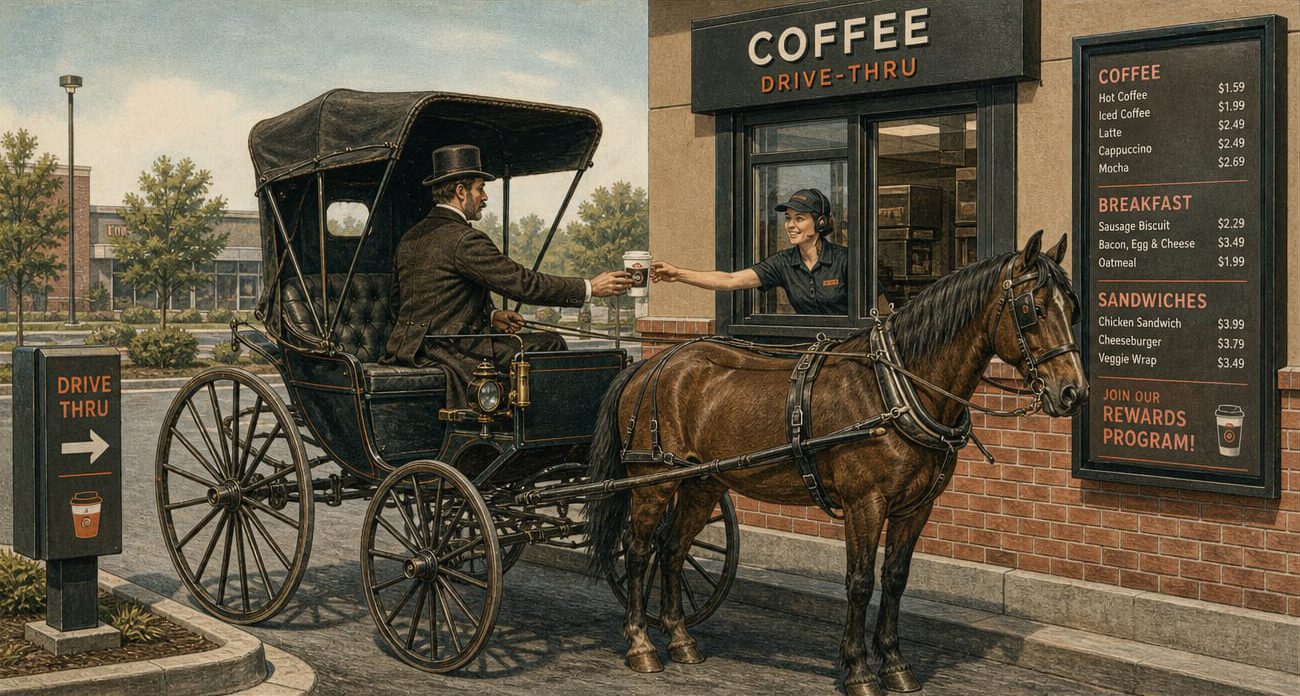
In 1884, if there had been a coffee drive-through for horses and buggies, a cup of coffee might have cost the driver 10 cents for an Americano or 17 cents for a latte—sipped while jostling along, cup in hand, toward a standard 10-to-12-hour workday at 10 to 40 cents an hour.
The Table of Average Cost of Material used in Cooking, dollar amounts in bold from the following list, is taken from Mary J. Lincoln’s 1884 Mrs. Lincoln’s Boston Cook Book, written from her work at the Boston Cooking School. The times are for the standard 10 to 40 cents hourly wage. Family gardens and home preserving aside, this is what ingredients could cost when they had to be bought in the Boston market from October through June:
1 cup of flour or meal $0.01 = about 6 to 1½ minutes of work
1 cup of sugar .06 = about 9–36 minutes of work
1 cup of butter .20 = about 30 minutes–2 hours of work
1 egg .03 = about4½–18 minutes of work
1 cup of molasses .05 = about 7½–30 minutes of work
1 cup of milk .02 = about 3–12 minutes of work
1 tablespoonful of wine .02 = about 3–12 minutes of work
1 tablespoonful brandy .04 = about 6–24 minutes of work
1 teaspoonful of vanilla .02 = about 3–12 minutes of work
1 teaspoonful of spice .02 = about 3–12 minutes of work
1 teaspoonful of soda, and 2 teaspoonful of cream-tartar .02 = about 3–12 minutes of work
1 tablespoonful of butter .03 = about 4½–18 minutes of work
Butter size of an egg .05 = about 7½–30 minutes of work
1 tablespoonful of olive oil .02 = about 3–12 minutes of work
2 tablespoonfuls of coffee .05 = about 7½–30 minutes of work
2 teaspoonful of tea .01 = about 1½–6 minutes of work
1 quart of milkman’s cream .25 = about 38 minutes–2½ hours of work
1 quart of Deerfoot cream .60 = about 1½–6 hours of work
1 box of gelatine .16 = about 24 minutes–1 hour 36 minutes of work
1 lemon .02 = about 3–12 minutes of work
1 orange .03 = about 4½–18 minutes of work
1 pound of raisins .18 = about 27 minutes–1 hour 48 minutes of work
1 pound of currants .10 = about 15 minutes–1 hour of work
1 pound of citron .18 = about 27 minutes–1 hour 48 minutes of work
1 pound of crackers .10 = about 15 minutes–1 hour of work
1 pound of tapioca .07 = about 10½–42 minutes of work
1 pound of rice .09 = about 13½–54 minutes of work
1 pound of macaroni .18 = about 27 minutes–1 hour 48 minutes of work
1 pound of spaghetti .16 = about 24 minutes–1 hour 36 minutes of work
1 pound of cornstarch .10 = about 15 minutes–1 hour of work
1 can of tomatoes .15 = about 22½ minutes–1½ hours of work
1 can of salmon .18 = about 27 minutes–1 hour 48 minutes of work
1 can of lobster .15 = about 22½ minutes–1½ hours of work
1 can of devilled ham and tongue .30 = about 45 minutes–3 hours of work
1 tumbler of jelly .35 = about 53 minutes–3½ hours of work
1 jar of marmalade .25 = about 38 minutes–2½ hours of work
1 pound of tea .75 = about 2–7½ hours of work
1 pound of coffee .38 = about 1–4 hours of work
1 pound of chocolate .40 = about 1–4 hours of work
1/4 pound of nutmeg .32 = about 48 minutes–3 hours 12 minutes of work
1/4 pound of mace .60 = about 1½–6 hours of work
1/4 pound of cloves, cassia .15 = about 22½ minutes–1½ hours of work
1/4 pound of ginger .10 = about 15 minutes–1 hour of work
1/4 pound of mustard .12 = about 18 minutes–1 hour 12 minutes of work
1/4 pound of herbs, ground .10 = about 15 minutes–1 hour of work
Package of whole herbs .08 = about 12–48 minutes of work
1 pound of cheese .18 = about 27 minutes–1 hour 48 minutes of work
1 pound of Parmesan cheese .50 = about 1¼–5 hours of work
1 peck of potatoes .25 = about 38 minutes–2½ hours of work
1 peck of apples .50= about 1¼–5 hours of work
1 quart of onions .10 = about 15 minutes–1 hour of work
1 carrot .02 = about 3–12 minutes of work
1 turnip .05 = about 7½–30 minutes of work
1 bunch of celery .20 = about 30 minutes–2 hours of work
1 handful of parsley .05 = about 7½–30 minutes of work
1 bunch of watercress .05 = about 7½–30 minutes of work
1 head of lettuce .10 = about 15 minutes–1 hour of work
The Boston Cook Book, 1884.
“These [1884] prices are for the best materials, and are estimated for the season, from October to June, when butter and eggs are higher than during the summer.” — Mary J. Lincoln