January 2012

Pyrex

by Rena

Pyrex was invented in 1913, and Corning Glass started selling it in 1915. It was promoted by Sarah Tyson Rover, editor of Ladies Home Journal and Good Housekeeping. Rover used demonstrations across the nation to help people get accustomed to cooking with PYREX, a clear borosilicate glass. Now PYREX is made with tempered soda-lime glass. Read The History of Pyrex Glass

When you see Pyrex from 1883, there may be a discrepancy! eBay Auctions

We hear the Mystery Chef’s 1938 biscuit recipe is great. Does anyone have it? Comment here. Then we can put the following Mystery Chef’s butter on it! The Mystery Chef’s butter recipe is contained within this script of one of his radio cooking shows between 1932 to 1945: You have to register to hear the audio version. Meanwhile, here is a partial script:

[Intro music]
“Good Day! This is the Mystery Chef. Thank you for honoring me by inviting me into your home. And what’s more let me thank you for your very delightful and very helpful letter. As promised, I shall start my little chat on the art of…cooking by giving you the “Butter Stretcher” recipe for the benefit of those who have missed it.

“With butter recently raised to 10 red points, I believe this butter recipe should be in every home in America, and Canada. Letters include the actual praising the recipe are still arriving by every mail. Here are actualy quotations: “The best butter I ever tasted.” “I wouldn’t take a hundred dollars for your Butter Stretcher recipe.” Another: “Now I can give the children all the bread and butter they want without saying, ‘Go easy on the butter.’” Still another: “Your Butter Stretcher recipe has solved my greatest breaking problem, as my family will not use anything but butter at the table. Now they can have it, and they all like it better than the ordinary butter. Thanks a million to you!”

“A thousand of enthusiastic letters have been received. But still there are many who have missed the recipe and have asked that I give it again. There’s countless radio friends who can not find any substitute for butter that they care to use; would rather eat their bread without butter than spread it with any butter substitute. Now, by using the recipe I shall give you now, you can continue to give the children all the enriched bread and butter they should have, to give them the energy they all need, used up in their strenuous play. As a matter of fact we should all eat plenty of enriched bread and butter for needed energy.

“Here’s the recipe. Please listen carefully. It’s a very easy recipe. You’ll have absolutely no difficulty in remembering it, even if you do not have writing materials handy.

“Listen:

“Take half a pound of butter and cream it. Now that means to stir it and stir it with a large spoon until the butter is soft and quite creamy. Then you break a whole egg into the creamed butter and you beat it with a rotary egg beater. Now you can use an electric beater if it has a slow speed. And when the whole egg is beaten into the butter, you warm a half pint of cream to body temperature. Now that is a half pint of light cream. One cup and you heat it only to body temperature. Then you add one tablespoon full of the warm cream to the butter and beat it in. And then add another tablespoon of warm cream and beat it in. Continue to add the warm cream one tablespoon at a time; and you must beat each tablespoon in before you add the next. When all is added the whole mixture will be very soft. Place it in your refrigerator and it will be hard and ready to serve in less than an hour. Okay, so if light cream can not be obtained, then use evaporated milk in place of the cream.

“Butter contains Vitamen A and D. And fresh butter vitamen A, B, C, D and G. Also contains calcium phosphate and iron, The last treatment will be contained in the egg.

“And if you have been using one of the other butter stretcher recipes, such as mixing butter and margarine, or by using gelatine, then compare the butter made by the recipe I’ve just given you, which dairy products only are used. You’ll find it so much better. There really is no comparison!

“Now before I give you my recipe for the day, I think I better say, now a word to all who have asked me to give my “Easy Fruit Canning” recipe….”

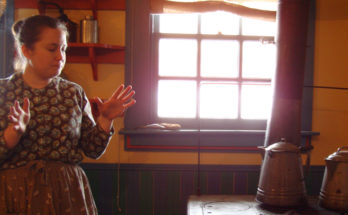
Wood-burning Stove cooking class at Living History Farms, 2012.Today kicked off the first class of 2012 at the Living History Farm near Des Moines, Iowa. The class was “Cooking on a Wood-burning Stove.” Besides learning how to build a fire in the 1871 cast iron stove, complete with working the drafts, the 5 adult students made Beef Stew, French-style Green Beans with lemon, Braided Onion Bread, and a chocolate dessert–all while working under lights of the oil lamps. Like

…more Living History Farm

By 1916 Mrs. Lincoln’s Boston Cook Book was the standard culinary textbook in Oklahoma public schools. Before 1916, the textbook Austin’s Domestic Science was known to be used. Here is a pdf copy of a later edition of the Oklahoma school textbook, Austin’s Domestic Science. Note: The pdf eBook may take a minute to appear.

In another old cook book, Modern Women of America Cook Book, two modern women from 1913 Oklahoma share their “Smothered Chicken” recipes.

Smothered Chicken.

One young chicken, one-half cupful butter, little lard, yolks two eggs, one cup cream, three potatoes, one onion, stalk celery. Dress and cut up a nice young chicken. Put the butter and lard in a deep frying pan and when very hot put in the chicken, dredged in flour. Slice the potatoes and onions one-quarter of an inch thick and lay on top of the chicken and add the celery chopped fine, and the seasoning. Fry until brown, then without turning pour on enough hot water to cover. Cover closely and cook until tender. Beat the yolks of the eggs and add the cream. Be sure the chicken is covered with water, then add the thickening and let boil up once. A year-old chicken can be used.—Mrs. Walter Thrasher, Oklahoma City, Oklahoma, 1913.

Smothered Chicken.

One large chicken, flour, seasoning, butter. Dress and cut up the chicken as for frying. Dredge with flour and place in a dripping pan. Season, add a little butier and cover with boiling water. Put in the oven and bake until tender.—Mrs. Etta Owen, Poarch, Oklahoma, 1913

Remember to catch the Smithsonian’s exhibit at six locations in Oklahoma in 2011-2012, “Key Ingredients: America By Food.”

Thank you to Oklahoma Pastry Clothe Company for duplicating historic recipes from the original Austin’s Domestic Science book.

Visit Jennifer McKendry’s website for pictures of toy miniature kitchens & dining-rooms from the 1880s to 1920s. They’re probably not just for children! Like

Mary Beth White received her grandmother’s cooking school textbook, Austin’s Domestic Science. In her blog at Oklahoma Pastry Cloth™ she cooks from the recipes in the book, and illustrates the process with photos. Very readable.

“Some call it “pretending” but I like to call it “supposin’ ” when, every so often, I whisk myself back (in my mind of course) to the late 1800′s and early 1900′s wondering what it would be like to

The Historical Museum Bern in Switzerland portrays Caleb Bradham, inventor of Pepsi Cola, at his North Carolina drugstore. Pepsi was first called Brad’s Drink, and in 1903 Bradham changed the name to Pepsi (referring to pepsin) Cola (referring to the original ingrediant Kola nuts). Like

Mercy Ingram gives helpful hints on open hearth cooking at the 1700s Pomona Hall in Camden, New Jersey. Like

Another video about hearth cooking:

SCROLL TO THE BOTTOM OF THE PAGE IN THIS LINK, SELECT A STATE, AND PUSH THE SEARCH BUTTON TO VIEW ALL OF THE FOOD MUSEUMS IN YOUR STATE.

Historic Deerfield’s Open Hearth Cooking Program

Listen to little known facts about wild game, narrated while cooking breakfast. Slow to start. See video.

Mid-Century Modern Frost-Free Refrigerators

More 1950s refrigerator videos:

From the junk yard to the vintage appliances we love so much. See vintage stove dealers.

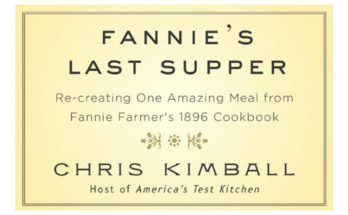
Chris Kimball took two years planning this one reenactment dinner proposed in an 1896 book by Fannie Farmer, legendary cook book writer and cooking instructor and principal of the Boston Cooking School. Farmer opened her own school, Miss Farmer’s School of Cookery in 1902. The reenactment dinner was held at Kimball’s home in the same area of Boston where Fannie Farmer had lived over 100 years earlier. His preparations started from the ground up, supplying his kitchen with a built-in wood-burning range built into the fireplace. Kimball lived to write about it in his book, Fannie’s Last Supper: Re-creating One Amazing Meal from Fannie Farmer’s 1896 Cookbook. The dinner was also filmed, click here for the trailer.

Tributes to Fannie Farmer
What Fannie Farmer Means to Me from In Our Grandmothers’ Kitchens

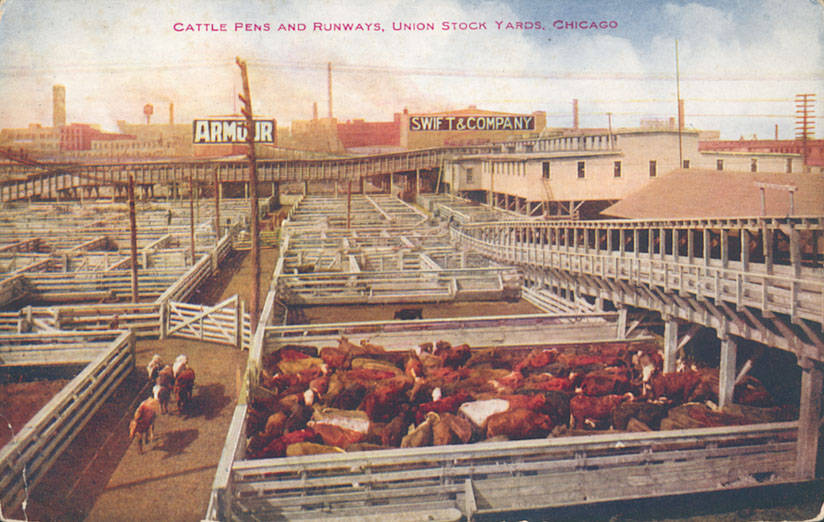
Enter the immense yards [in 1898] beneath the plain, massive arch that bears the inscription, “Union Stock Yards, Chartered 1865″ and you will readily grasp the meaning and value of the system. It is a region of order and death, but a sight that will stir the most casual onlooker or the deepest philosopher. It is a city in itself–a city of pens and factories, immense and noisy. Wherever the eye wanders, the most intense activity prevails….In 1865 there were 330,301 cattle received and shipped live, and 27,172 cattle and 507,355 hogs packed. — The Chicago Packing Industry eBay Auction